
How to add pronunciation scoring to your voice agent with MCP
Connect a voice agent to a Pronunciation Assessment MCP so LLMs can coach from structured speech evidence—not guessed scores.
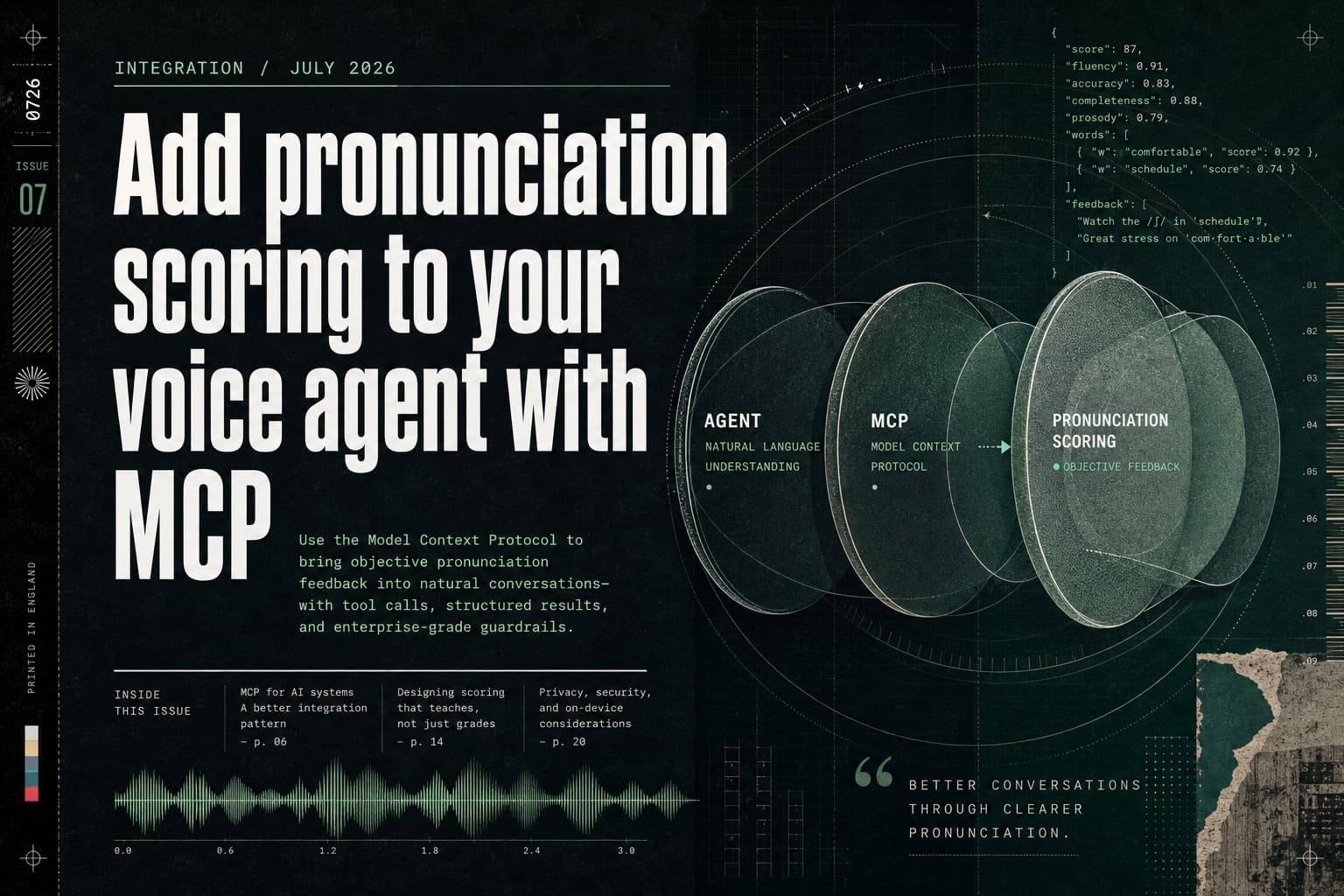
Voice agents can already understand spoken questions and generate conversational responses. What most LLMs still cannot do is objectively evaluate pronunciation quality. A Pronunciation Assessment MCP closes that gap by exposing speech scoring as a reusable tool the agent can call.
Why conversation alone is not enough
A voice agent can translate, explain grammar, and guide exercises. Language learning also needs objective feedback on pronunciation accuracy, word-level performance, phoneme errors, fluency, prosody, and reading completeness.
Asking the model to estimate pronunciation from a transcript is unreliable. Modern systems invoke a dedicated speech assessment service instead, then let the LLM turn structured results into coaching language.
What a Pronunciation Assessment MCP is
A Pronunciation Assessment MCP is a Model Context Protocol server that exposes pronunciation scoring as a tool. Developers register the assessment service once. Agents call it whenever evaluation is required.
The MCP returns structured assessment results the LLM can interpret. Conversational reasoning and speech assessment stay separate, but they work together in one workflow.
A practical four-step integration
1. Register the MCP server in your MCP client after creating a Chivox AI developer account. 2. Invoke pronunciation assessment with learner audio and the expected reference text. 3. Receive structured JSON results—scores, diagnostics, and validity signals your app can process. 4. Let the AI tutor coach the learner in natural language instead of dumping raw metrics.
Example coaching style: acknowledge what worked, name one concrete fix, and invite an immediate retry. That combination of objective scoring and conversational teaching is the product.
Why MCP instead of only direct API calls
REST APIs remain valid. MCP adds advantages for AI-native apps: standardized tool invocation, reusable integrations across agents, simpler orchestration, easier maintenance, and cleaner architecture as more platforms adopt the protocol.
If you already build with tool-calling agents, MCP turns pronunciation scoring into the same class of capability as search or retrieval—callable, typed, and inspectable.
Use cases and best practices
Common fits include AI language tutors, speaking practice apps, K–12 classroom speaking activities, educational robots, and corporate spoken-English training.
Practical habits that improve outcomes: - Prefer high-quality audio input - Keep reference text synchronized with the speaking task - Combine objective scores with LLM explanations - Track progress across sessions - Personalize later lessons from pronunciation history - Validate with recordings from your target learners, especially children and multilingual speakers