
Mandarin tone assessment: why it is hard—and how modern AI makes it possible
Tone carries meaning in Mandarin. That is why ASR is not enough—and why dedicated pitch-aware assessment matters for Chinese learning products.
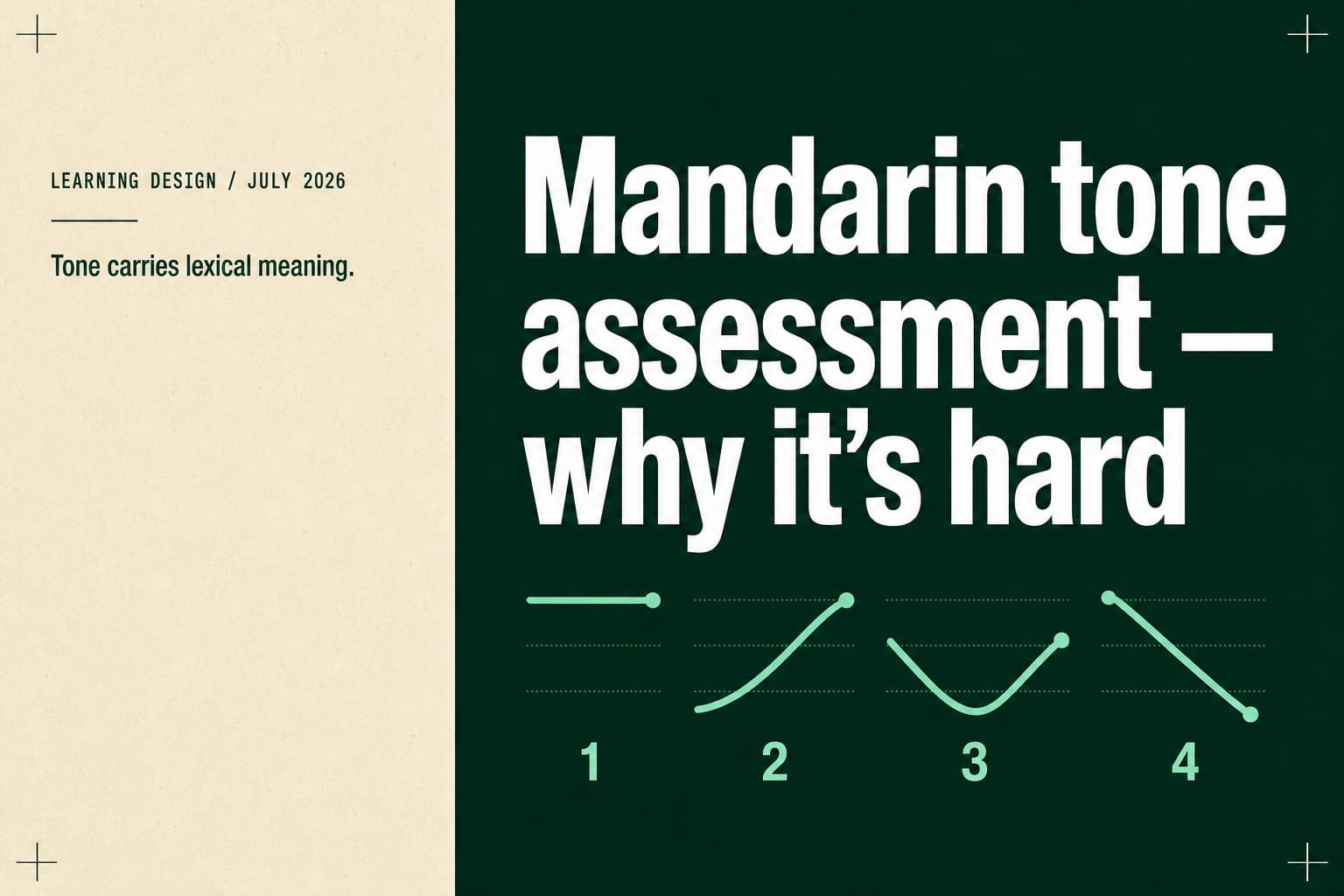
Learning Mandarin pronunciation is fundamentally different from learning pronunciation in many other languages. Changing only the tone can completely change meaning—for example, 水饺 (dumplings) versus 睡觉 (to sleep). That single fact reshapes what speech technology must measure.
Why Mandarin is different
Mandarin is a tonal language with four primary tones and one neutral tone. Tone carries lexical meaning, so accurate pronunciation is not optional polish—it is part of saying the intended word.
Products that only confirm “the learner said something close to the transcript” can miss the error that matters most.
Speech recognition is not tone assessment
Speech recognition identifies what was said. Tone assessment evaluates how accurately it was pronounced—especially pitch contour and tone target.
A system can recognize the intended syllable while still failing to judge whether the contour was flat, rising, falling, or fall-rising. Those are different jobs, and they need different signals.
Why tone assessment is difficult
Useful Mandarin assessment has to analyze pitch contour, tone transitions, pronunciation accuracy, fluency, rhythm, and prosody—not only recognize words.
Real learner audio adds harder cases: tone sandhi, connected speech, children’s voices, speaking speed variation, and contextual pronunciation. Classroom noise and short utterances make contour estimation even less forgiving.
This is why generic ASR confidence is a weak proxy for Mandarin coaching quality.
What a modern AI pipeline looks like
A typical educational pipeline includes audio preprocessing, speech recognition, forced alignment, acoustic modeling, pitch extraction, tone evaluation, pronunciation scoring, and feedback generation.
The educational value appears at the end of that chain: tone accuracy, word- and sentence-level scores, fluency and prosody signals, confidence measures, and structured JSON outputs that tutors and UIs can consume.
What Chivox AI provides for Mandarin products
Chivox AI supports Mandarin pronunciation assessment, tone evaluation, fluency analysis, reading assessment, cloud APIs, structured JSON responses, and MCP-compatible integration for EdTech.
Dedicated Mandarin tone assessment lets AI tutors and Chinese learning applications deliver coaching beyond basic speech recognition—especially when meaning depends on getting the contour right.