
Function calling for predictable speech tools
How typed inputs and inspectable outputs make speech capabilities easier to place inside an agent workflow.
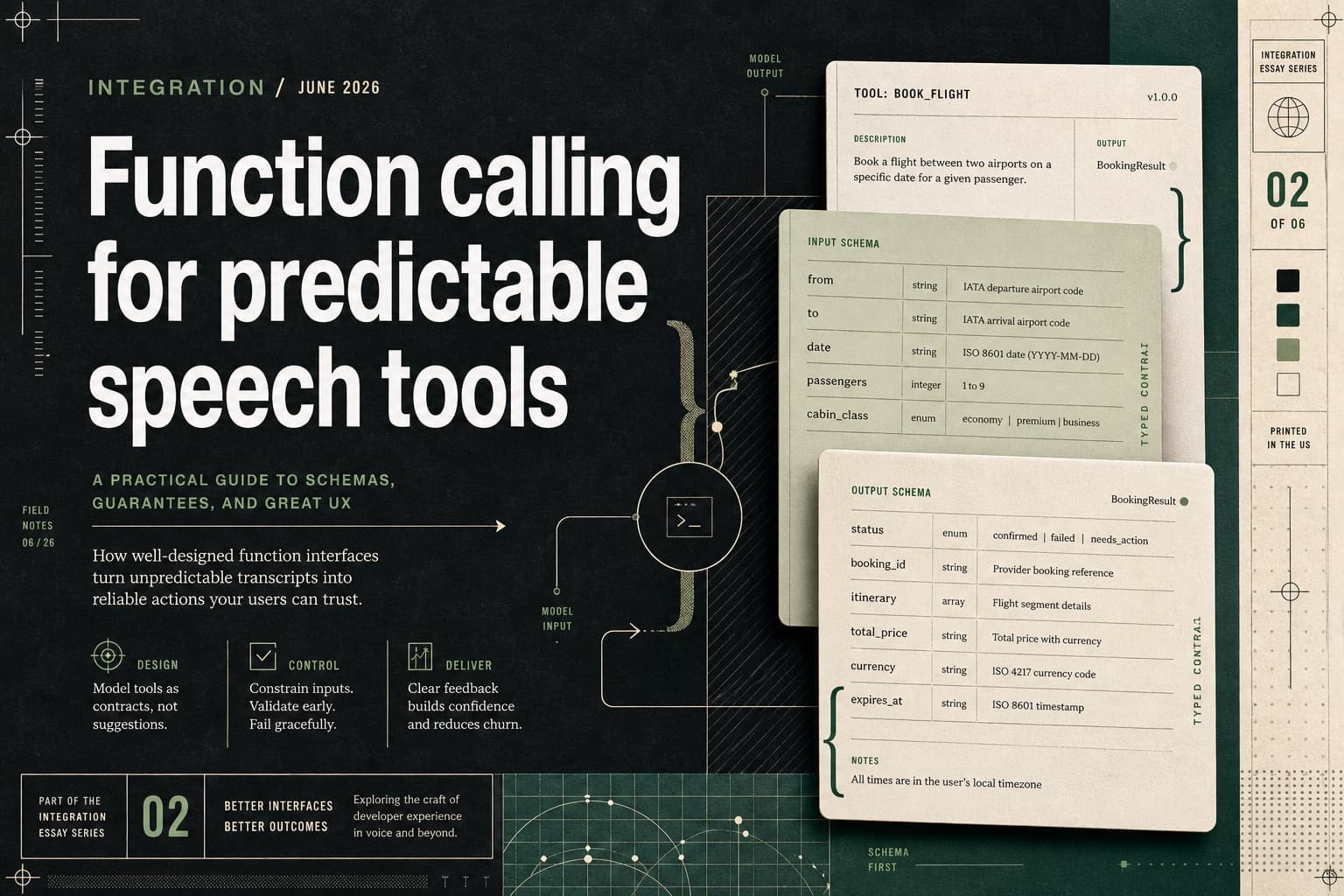
Speech assessment becomes easier to operate when the agent invokes it through a clear contract rather than relying on prompt conventions alone. Function calling turns listening into a tool with typed inputs, inspectable outputs, and predictable failure modes.
Keep the contract small
Expose only the inputs the agent can reliably provide, such as audio, reference text, language, and assessment mode. Defaults should be explicit and safe.
Every optional field is a chance for the agent to invent a value. Prefer a short contract with strong defaults over a flexible contract that needs constant prompt policing.
Return fields that support a decision
A useful response combines a concise summary with evidence the agent can cite. Avoid forcing the model to reconstruct basic meaning from a deeply nested payload every time.
Include: - overall scores - top issues - validity flags - a short machine-readable reason code
Then let the agent write the learner-facing explanation from those fields.
Treat retries as product behavior
Define which failures are safe to retry and which require new user input. That policy belongs in the workflow, not in an improvised error prompt.
Network timeouts may be safe to retry once. Empty audio is not. Quota exhaustion is not. Distinguishing those cases in the tool result keeps agents from looping endlessly or blaming the learner for infrastructure problems.
Version the tool like an API
Agents accumulate prompts, evaluations, and downstream parsers around a tool schema. Changing field names casually breaks more than documentation.
Version the function, publish example payloads, and keep a compatibility window. Speech tools deserve the same discipline as billing or auth APIs because they sit on the critical path of the conversation.
Test the tool independently of the chat
Before trusting an agent demo, validate the speech tool with fixed audio fixtures. Confirm score ranges, failure codes, and latency under expected load.
Once the tool is stable, evaluate the agent’s use of it. Mixing both layers in one test makes regressions hard to attribute.