Seven questions to answer before adding speech assessment
A short alignment guide for product, curriculum, engineering, and procurement teams.
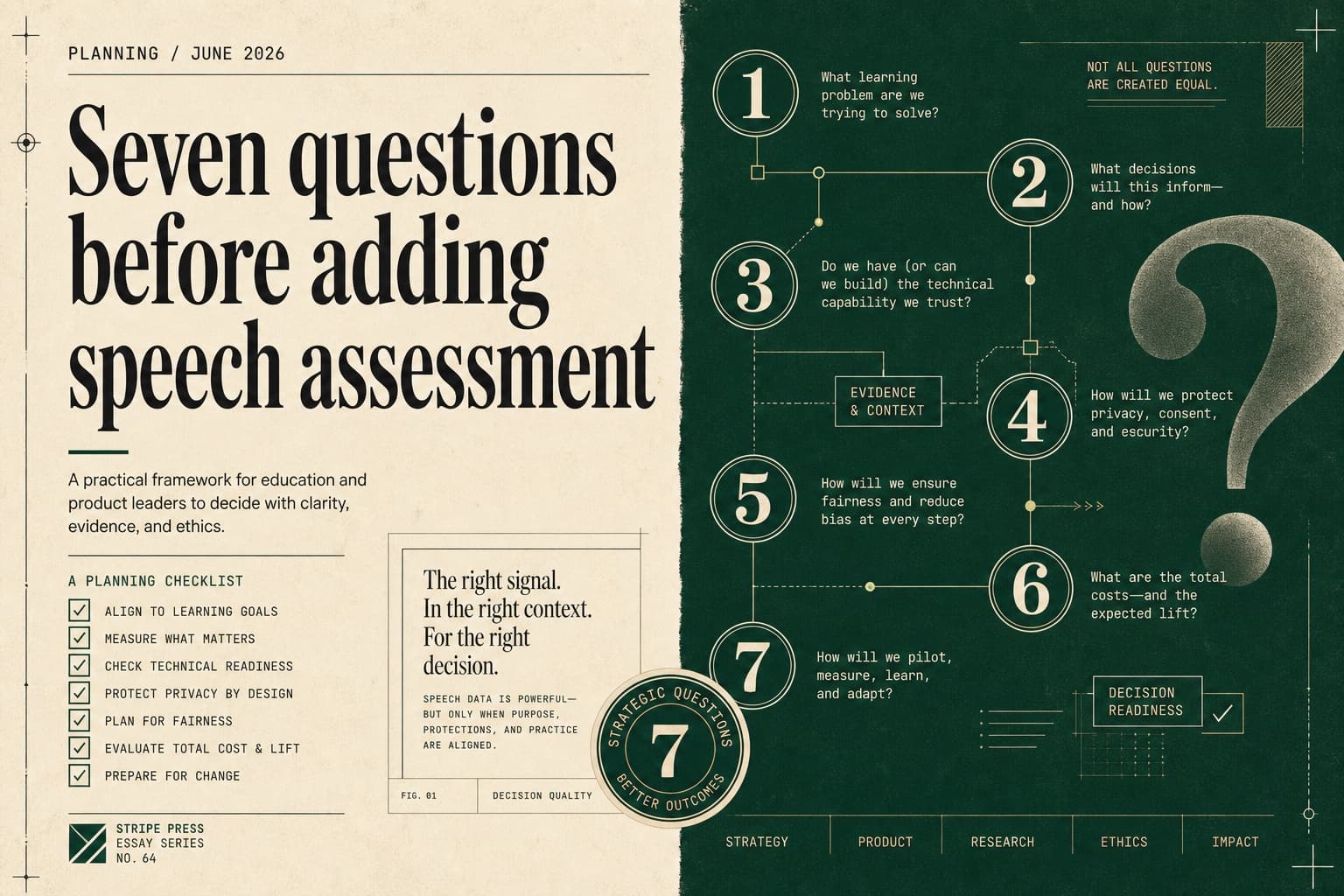
The best integration plan starts with the learner experience and works backward to technical requirements, measurement, and operations. These seven questions help product, curriculum, engineering, and procurement teams align before the first sprint.
What decision will the score support?
Be specific about whether the product is coaching, placing, certifying, or simply encouraging practice. Each use case needs a different feedback threshold and level of explanation.
A practice product can tolerate softer signals and frequent retries. A placement or certification product needs clearer thresholds, auditability, and escalation paths.
Which evidence must be visible?
Decide what learners, teachers, support teams, and internal analysts each need to see. One response can support several views without showing everyone the same complexity.
If teachers need phoneme detail and learners only need one next tip, design both views from the start. Retrofitting evidence visibility later usually means reworking storage and UI together.
How will you evaluate the pilot?
Choose a small set of experience and system metrics before launch: completion, retry rate, teacher agreement, latency, and failure recovery are useful starting points.
Write the success criteria down. Otherwise the pilot ends with anecdotes instead of a ship decision.
What languages and task types matter first?
Do not launch on “speech” in the abstract. Name the first language pair, the first task type, and the first learner segment.
Word reading, sentence read-aloud, open response, and conversational turns create different product and assessment requirements. A narrow first slice ships faster and teaches more.
Who owns the operating model?
Speech features create ongoing work: key management, spend review, content QA, teacher training, and support macros. Assign owners before procurement closes.
If nobody owns the operating model, the integration becomes a demo that quietly degrades after launch.
What happens when audio is bad?
Quiet rooms, shared devices, and rushed recordings are normal. Define the learner message and the retry policy before engineering starts.
Products that ignore invalid-audio handling create false coaching and unnecessary distrust in the score.
What is the minimum lovable loop?
Pick the smallest loop that feels valuable: record, score, explain one issue, retry once. Expand only after that loop is reliable.
Many speech roadmaps stall because the first release tries to solve assessment, tutoring, reporting, and certification at the same time.