
Grounding voice agents with structured speech evidence
Why a transcript alone is not enough—and how phoneme, fluency, and audio-quality signals create better agent decisions.
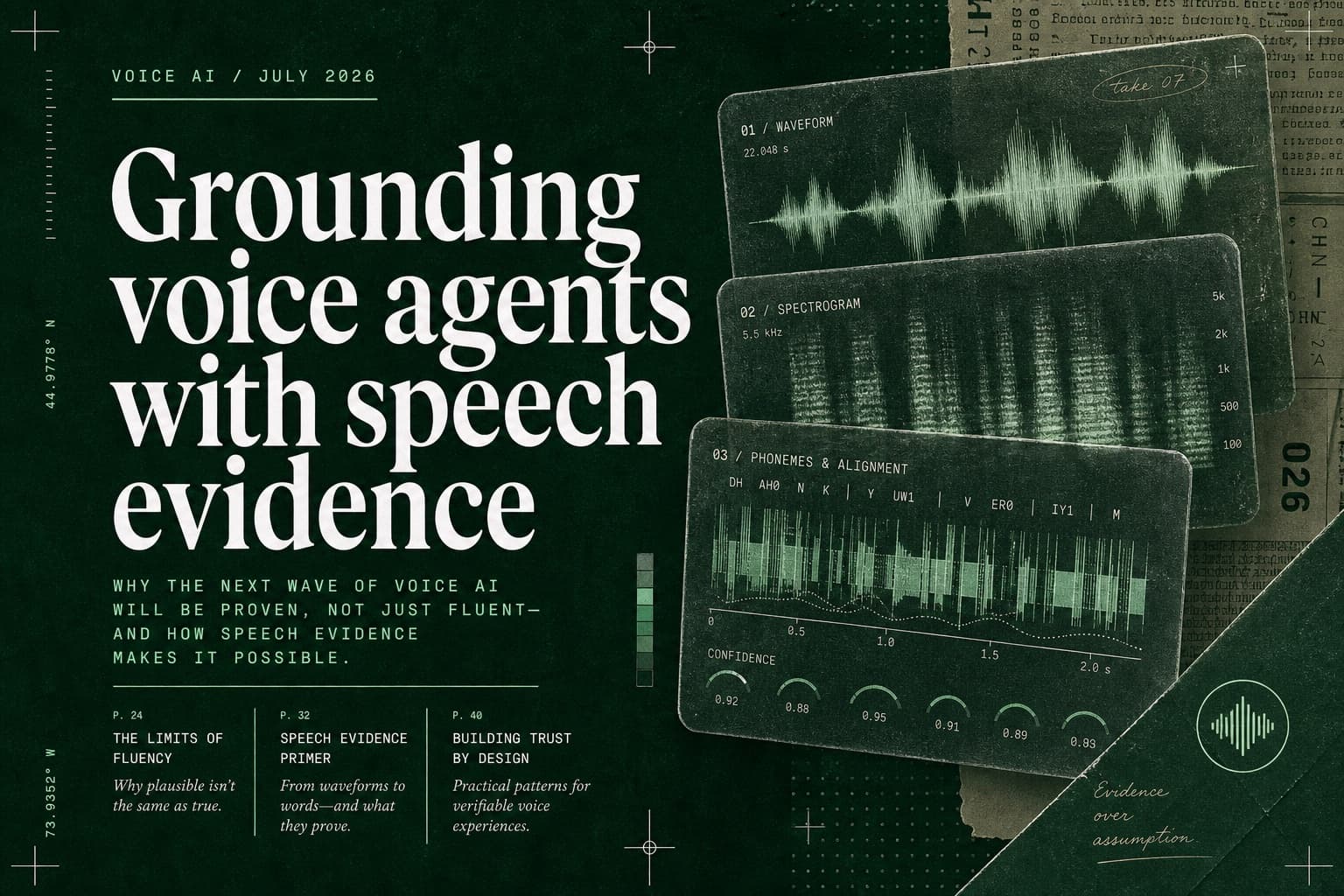
A transcript tells an agent what was said. Structured speech evidence helps it understand how it was said, where communication broke down, and what to do next. That difference matters the moment a product stops demoing and starts coaching real learners.
The transcript is only one layer
Two speakers can produce the same transcript while creating very different listening experiences. One may be clear and confident. The other may be hesitant, clipped, noisy, or phonetically unstable in ways that still pass automatic speech recognition.
Pronunciation confidence, pauses, rhythm, background noise, and clipping all affect whether an agent should confirm, coach, retry, or continue. If your workflow only passes text into the model, those signals disappear before the decision begins.
Treat the transcript as necessary context, not as the full speech record.
Give the model inspectable evidence
Instead of asking an LLM to infer speech quality from text, pass a compact set of typed fields: overall scores, word and phoneme details, fluency events, and audio-quality flags. The model can then explain a decision using evidence your team can inspect.
A useful payload is small enough to fit in a tool result, but rich enough to answer three questions: Was the attempt valid? Where did it fail? What should happen next?
Keep the schema stable across products. Agents improve faster when the same phoneme, fluency, and quality fields appear in every coaching loop.
Design the action before the explanation
Start with the product action you need—accept, clarify, coach, or escalate—then define the minimum evidence required to support it. This keeps prompts shorter and prevents a rich payload from becoming an unstructured data dump.
For example, a placement flow may only need overall accuracy and audio validity. A tutor loop may need the top failing phoneme and one fluency event. A certification path may need a stricter threshold plus a human review flag.
When the action is clear, the explanation becomes a supporting layer rather than the main product.
Separate validity from performance
Many failed turns are not pronunciation problems. The mic was too quiet. The speaker cut off early. Background noise made the attempt unusable. Those cases need a retry, not a coaching monologue.
Put audio-quality gates ahead of pedagogical logic. If the attempt is invalid, ask for a cleaner recording. If it is valid but weak, coach. If it is valid and strong enough, continue.
This single separation removes a large class of confusing agent behavior.
Make evidence reusable across surfaces
The same speech result can power the learner UI, the teacher dashboard, analytics, and the agent prompt. Do not ask the model to invent a second version of the score for each surface.
Show learners a focused next step. Show teachers the full evidence. Let agents cite the same underlying fields. That keeps product language consistent and makes support conversations much easier to resolve.