
Why every AI language tutor needs a Pronunciation Assessment MCP
LLMs can converse, but they cannot objectively score pronunciation. An MCP-backed assessment engine makes speaking feedback measurable.
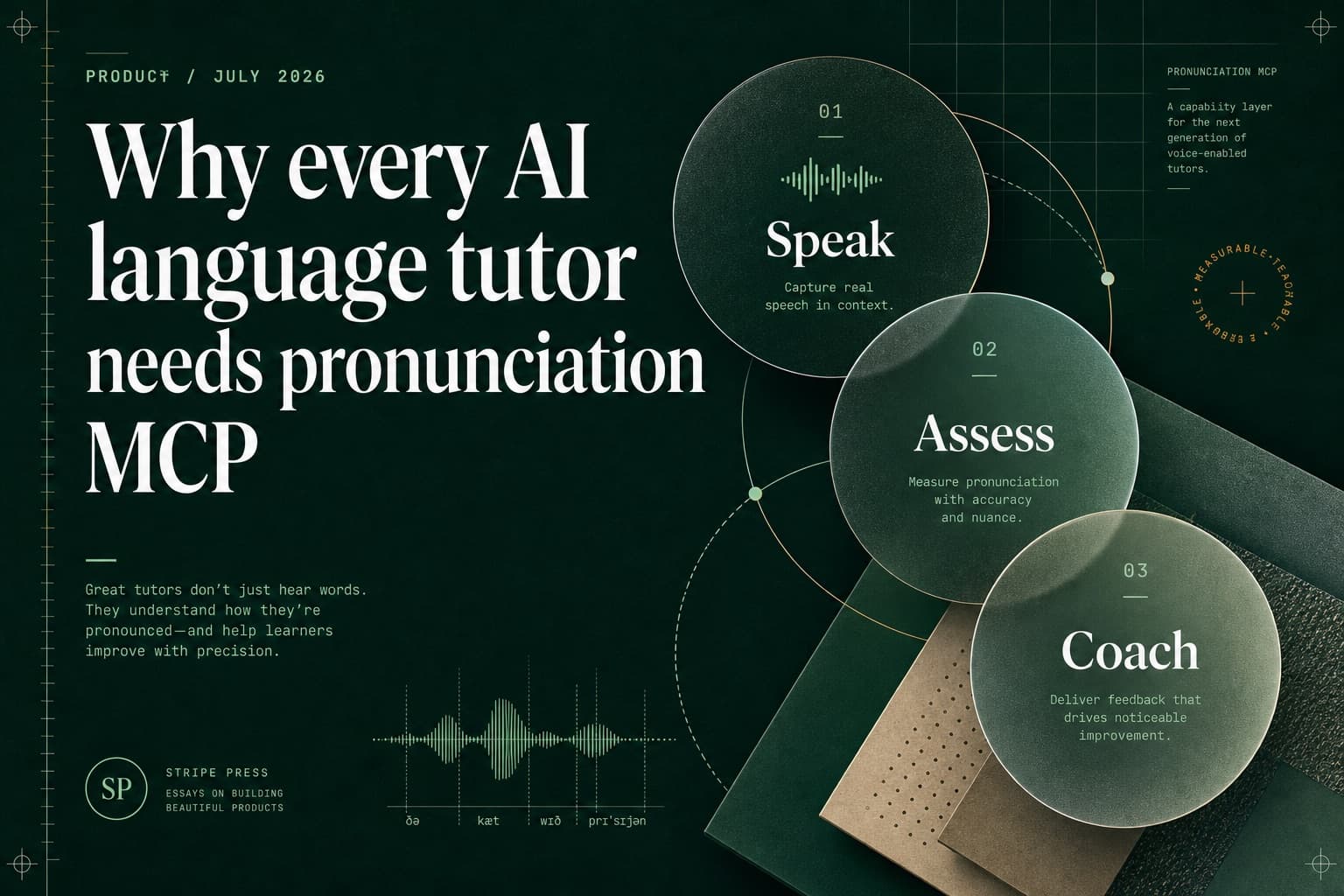
Modern AI language tutors can explain grammar, generate exercises, and hold natural conversations. They still cannot objectively evaluate pronunciation without a dedicated speech assessment engine. A Pronunciation Assessment MCP gives tutors a standardized way to call that engine and coach from evidence.
Spoken language is still the hard skill
Today’s tutors deliver adaptive learning experiences, but spoken language remains difficult to assess. Learners expect feedback on pronunciation, fluency, rhythm, and intonation—not only confirmation that speech recognition heard them.
Without an external scoring system, tutors improvise. Improvised scores drift, and progress becomes hard to trust.
Recognition is not assessment
Speech recognition identifies what a learner says. Pronunciation assessment evaluates how it is spoken: accuracy, word- and phoneme-level performance, fluency, prosody, completeness, confidence, and mispronunciation detection.
If your tutor only reacts to transcripts, it is missing the signals that make speaking practice useful.
How a tutor uses a Pronunciation Assessment MCP
A clean loop looks like this:
1. The learner speaks 2. Audio is captured 3. Audio is sent to the Pronunciation Assessment MCP 4. The MCP evaluates pronunciation and fluency 5. Structured scores are returned 6. The LLM explains mistakes and recommends practice 7. Progress is recorded for personalization
The MCP keeps scoring outside the prompt. The model stays responsible for teaching language, not inventing metrics.
What the assessment result should include
Useful tutor payloads typically include overall pronunciation score, word-level scoring, phoneme-level diagnostics, fluency, prosody, completeness, mispronunciation detection, confidence, and structured JSON responses.
You do not need to show every field to the learner. You do need those fields available so the tutor can choose one priority issue and so teachers or analytics can inspect the same evidence later.
Why EdTech teams adopt MCP for this
MCP provides standardized integration, modular architecture, easier maintenance, interoperability across AI frameworks, scalable deployment, and faster development of tutors and voice-enabled learning products.
Chivox AI’s education-focused engine—English pronunciation assessment, phoneme diagnostics, fluency and prosody analysis, reading assessment, real-time scoring, and structured JSON—fits cleanly behind that interface for AI tutors, K–12, speaking exams, corporate training, and voice-enabled learning apps.