Mandarin tone feedback that learners can actually use
Turn tone and Pinyin evidence into one focused retry instead of a wall of corrections.
Detailed scoring is valuable to a product team, but a learner needs a clear next move. Good feedback translates tone and Pinyin evidence into a small, achievable correction—then gives an immediate chance to try again.
Choose one teaching priority
When several syllables need work, prioritize the error that most changes meaning or most often repeats. This reduces cognitive load and makes the next attempt measurable.
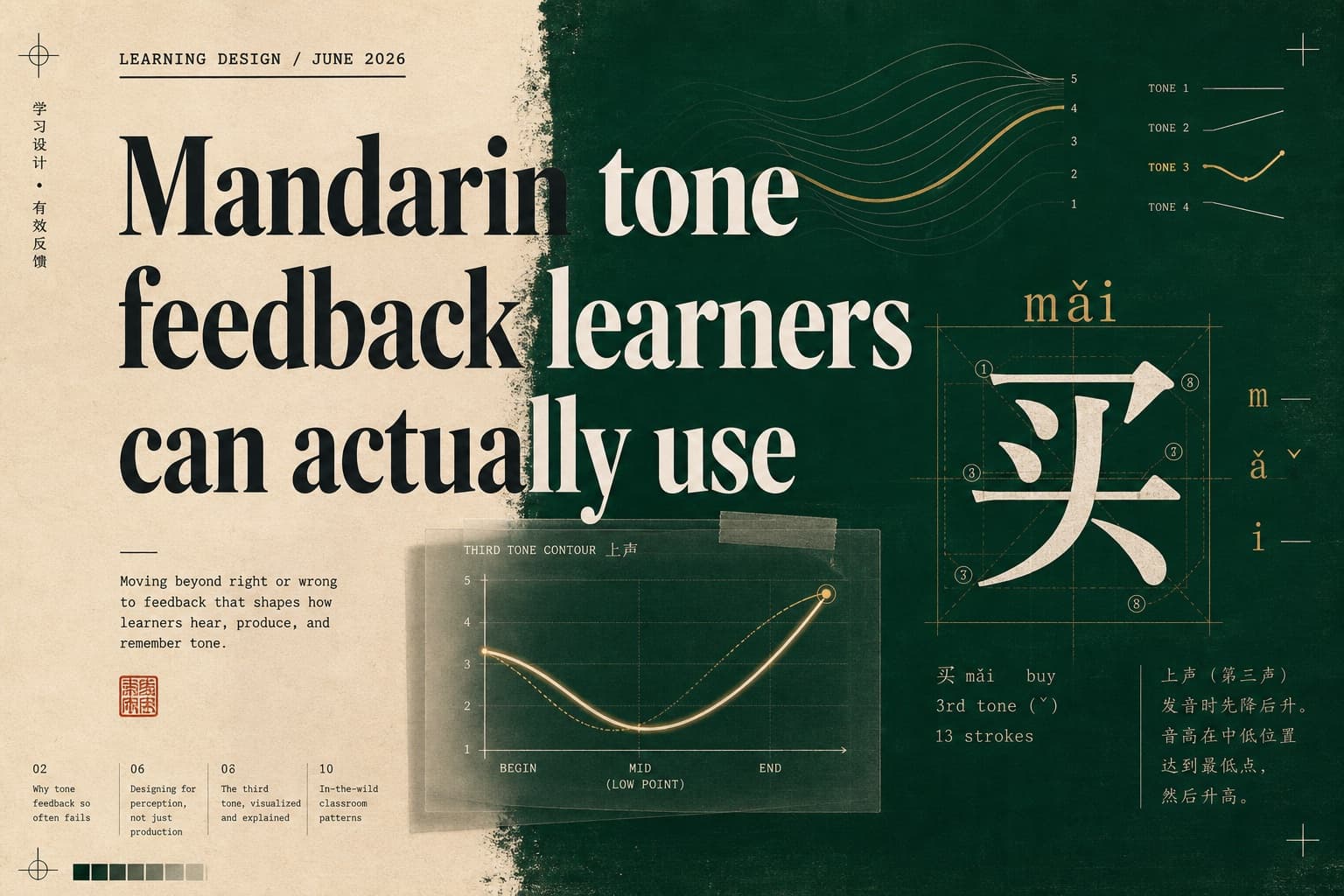
A learner who hears five corrections at once usually improves none of them. A learner who hears “make the third tone fall-rise clearer on 买” has a concrete target.
Curriculum designers should define priority rules up front so the product does not improvise a new pedagogy on every turn.
Show the contour, then let them retry
A short model, a simple tone cue, and an immediate recording opportunity work better together than a long explanation. Keep the feedback close to the action.
Visual tone contours help because learners can compare shape, not only labels. Pair the contour with one spoken model and one retry button. Anything else can wait for the teacher view or a later review screen.
Preserve the evidence for teachers
Learners can see a focused prompt while teachers and product teams retain the full tone, fluency, and pronunciation record for progress tracking.
This split is intentional. The learner interface optimizes for momentum. The teacher interface optimizes for diagnosis. Both should read from the same assessment result so progress reports stay trustworthy.
Measure improvement on the same syllable
After coaching, ask for the same target again before returning to free conversation. If the tone improves, acknowledge it briefly and move on. If it does not, change the drill rather than repeating the same sentence with the same vague advice.
Closing the loop on one syllable teaches the learner that practice has a measurable effect.
Avoid over-correcting fluent speech
Not every detectable tone deviation deserves interruption. In communicative practice, interrupt only when meaning is at risk or when the error matches the lesson objective.
Assessment engines can surface many signals. Learning products still need judgment about when silence is the better coach.